
SumerSystems Unveils SumerOS, the Operating System That Teaches Computers to Respect the Laws of Physics in Orbit
Nov 28, 2026
SumerSystems Corp. has unveiled SumerOS, a patent-pending orchestration platform for space-based computing that makes thermal, radiation, energy, network and storage conditions first-class inputs to every workload decision. The platform introduces a Physical State Vector for each node and is available today as a demonstration.
Sacramento, United States, November 28, 2026 -- SumerSystems Unveils SumerOS, the Operating System That Teaches Computers to Respect the Laws of Physics in Orbit
Patent-pending platform brings physical-state-aware orchestration to space-based computing for the first time, placing every workload by heat, radiation, power, connectivity and storage, not just CPU and memory
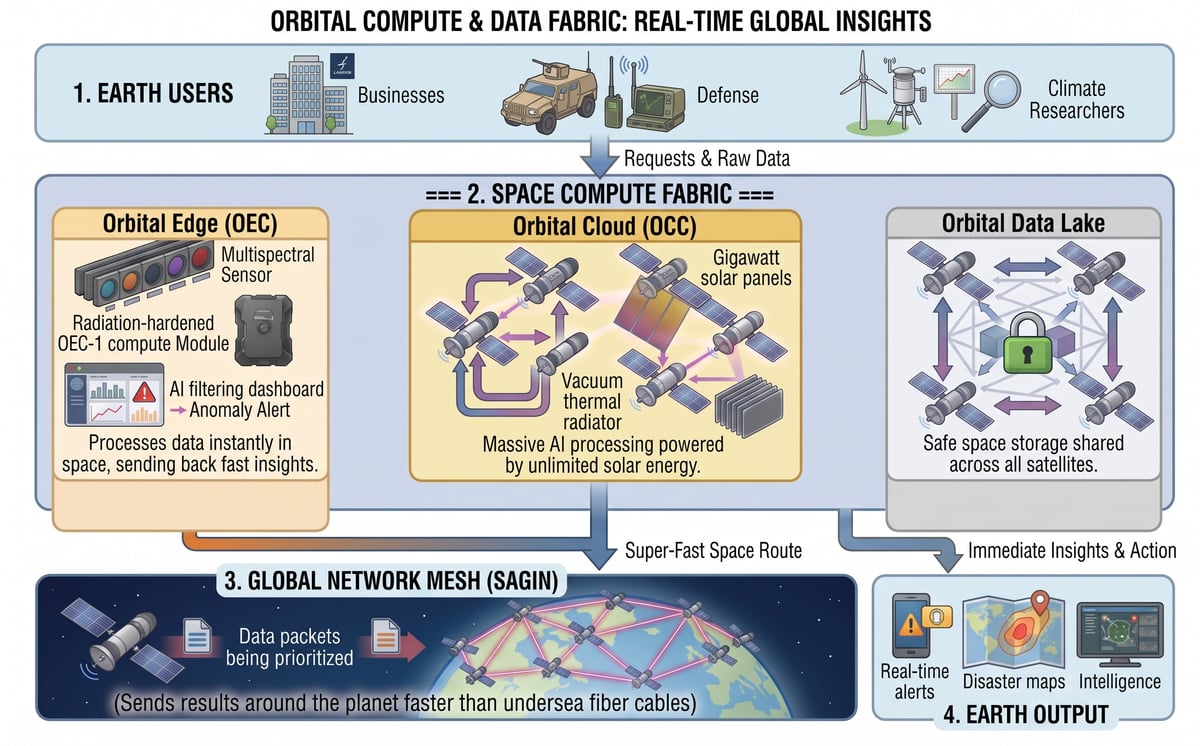
SACRAMENTO, CA – Nov 25th, 2026 – SumerSystems Corp. today unveiled SumerOS, a patent-pending orchestration platform built for a new era of computing in space. As satellites become AI-enabled, autonomous and compute-hungry, SumerOS introduces what the company believes is the first operating layer designed from the ground up to make physical conditions, including thermal margin, radiation exposure, energy reserves, communications windows and storage capacity, first-class inputs to every computing decision in orbit.
Computing in orbit has been running blind
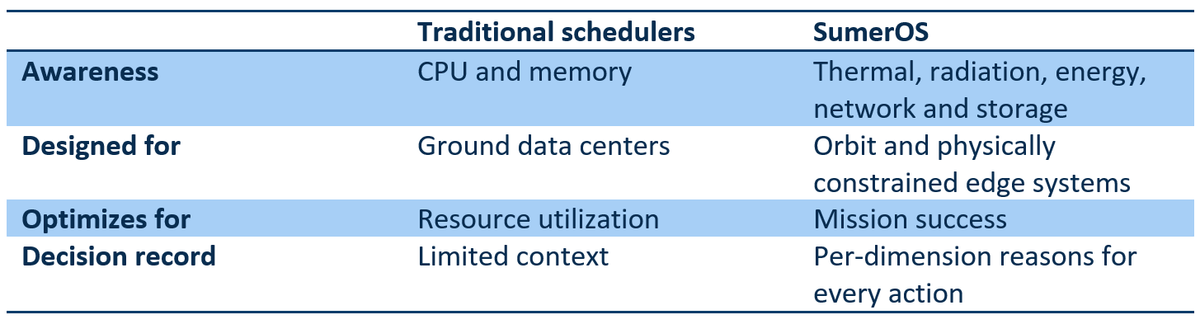
Today's schedulers were built for data centers on Earth. They allocate CPU, memory and storage, and assume the building, the power grid and the cooling system will take care of everything else. In orbit, that assumption breaks. A satellite can have plenty of spare processing power while it is minutes from overheating, about to slip into Earth's shadow and lose solar power, or moving toward a gap in ground communications.
In a single orbit, a spacecraft passes through several entirely different operating environments: sunlit peaks that heat its radiators, short downlink windows with hard deadlines, eclipses that leave it running on battery alone, and radiation passes where the risk of data upsets spikes. A scheduler that ignores these shifts either leaves valuable compute sitting idle or puts the mission itself at risk.
The breakthrough: a Physical State Vector for every node
At the heart of SumerOS is the Physical State Vector, a five-dimensional picture of each computing node's real-world readiness across thermal, radiation, energy, network and storage conditions. Rather than collapsing a node's health into a single number, SumerOS keeps each dimension visible, so operators can see exactly why a node was chosen, excluded or flagged.
Think of it as air-traffic control for computers. Capacity matters, but so do environmental limits, operating windows and contingency plans. SumerOS ranks every eligible node against the specific needs of each workload, excludes nodes in a critical state before ranking begins, and selects from five operational responses:
Place a new workload on the best-suited node
Migrate a workload away from a stressed node
Replicate critical work for added redundancy
Throttle demand to protect thermal and power margins
Defer non-critical work to a better operating window
Every decision is logged with its reasons, giving mission teams a transparent, explainable record rather than a black box.
"For sixty years we have asked how much compute we can launch into orbit. The better question is how intelligently we can use it once it is there," said Ash Sumer, Founder and CEO of SumerSystems. "SumerOS is the first platform built around a simple idea: the computer should understand the physics it lives in. When a satellite knows its own heat, power, radiation and link conditions, it can keep critical work running instead of waiting for something to go wrong."
First to market with a new category of infrastructure software
SumerSystems is entering a market where others are focused on connecting to space or sensing from it. SumerOS is built for computing in it. The company's provisional patent application, filed as "Space-Native Distributed Computing Infrastructure: System and Methods for Orbital Computing, Storage, Networking, Thermal Management, and Autonomous Resource Orchestration," covers physical-state-aware scheduling, thermal-aware workload placement, radiation-aware execution, eclipse-aware energy orchestration, autonomous workload migration, orbital compute orchestration and space-air-ground resource management.
See it in action
SumerOS is available today as a working demonstration environment that combines live orbital data from CelesTrak with simulated spacecraft telemetry. The experience includes a Command Center for fleet posture and decisions, a Digital Twin for node-level exploration, Mission Control for fleet oversight, a Scenario Simulator for testing thermal events, eclipse entry, radiation events and communication interruptions, and an Executive Dashboard for leadership-level visibility.
The company's development roadmap advances SumerOS from today's demonstration toward calibrated physical forecasting, policy-controlled autonomy with human approval and override, and hardware-in-the-loop pilots, so that action authority expands only as test evidence grows.
Early-access pilot program now open
SumerSystems is inviting satellite manufacturers, satellite operators, Earth observation providers, defense contractors and orbital infrastructure companies to join its early-access program. Engagements range from focused evaluation projects to engineering and integration pilots, each designed to answer the question every operator is asking: how do we get the most out of onboard compute without compromising mission reliability?
"Every constellation operator we talk to wants more capability from the hardware already in orbit," Sumer added. "SumerOS gives them a path to get it, with the transparency and safeguards that mission-critical systems demand."
The foundation for the Orbital Compute Network
SumerOS is the first building block of SumerSystems' long-term vision: an Orbital Compute Network that brings AI inference, data storage and high-speed routing to Low Earth Orbit. Spanning Orbital Edge Computing, an Orbital Data Lake, Orbital Cloud Computing clusters and Space-Air-Ground Integrated Networking, the network is designed to run under one scheduling authority, with SumerOS as its control plane. Beyond orbit, the same physical-state-aware approach applies to remote edge sites, telecommunications networks, autonomous defense systems and energy-constrained data centers.
About SumerSystems
SumerSystems, Inc. is developing SumerOS for future distributed computing infrastructure, beginning with orbital use cases and extending toward terrestrial edge and physically constrained systems. Founded by Ash Sumer, whose background spans AI systems, anomaly detection, cloud architecture, cybersecurity and enterprise SaaS, the company is building the software layer that will let computing infrastructure understand and adapt to the physical world around it. Learn more at www.sumersystems.com.
Media Contact
Ash Sumer, Founder and CEO, SumerSystems Corp.
Email: [email protected]
Web: www.sumersystems.com
Forward-looking statements: This release contains forward-looking statements about SumerSystems' products, roadmap and plans. SumerOS demonstration capabilities use simulated telemetry, and planned capabilities remain subject to development, testing and validation. Actual results may differ materially.
Contact Info:
Name: Ash Sumer
Email: Send Email
Organization: SumerSystems Corp.
Website: https://www.sumersystems.com
Release ID: 89211225
Should you detect any errors, issues, or discrepancies with the content contained within this press release, or if you need assistance with a press release takedown, we kindly request that you inform us immediately by contacting [email protected] (it is important to note that this email is the authorized channel for such matters, sending multiple emails to multiple addresses does not necessarily help expedite your request). Our expert team will be available to promptly respond and take necessary steps within the next 8 hours to resolve any identified issues or guide you through the removal process. We value the trust placed in us by our readers and remain dedicated to providing accurate and reliable information.
More News

Can You Match These 40 Countries To Their Continents?
How well do you know your geography? View Entire Post ›

If You Can Get 15/15 On This Geography Quiz, Your Mind Is Sharp Enough To Cut Glass
Where is the Acropolis? View Entire Post ›

NBC Pulls an Ad That Some Described as Antisemitic
The commercial appeared during a “Saturday Night Live” holiday special on Wednesday.

19 Cyber Week Deals On Things To Improve The Experience Of Traveling With Only A Carry-On
You’re going to save money now on these deals *and* on those pesky checked-luggage fees later on. View Entire Post ›

Ancient Chinese travel trends and how creatives found inspiration away from home
Now that I am based in Prague, travelling around Europe has become considerably more convenient and affordable. Located in the heart of the continent, the Czech capital puts many European destinations within just a few hours’ reach by air, rail or road. We have devised a system to decide where to go each weekend. We maintain lists of places we would like to visit, whether for a day trip or a longer excursion if time permits, and then pick our destination using an online raffle generator. This...
Biohacker Bryan Johnson drinks a shot of olive oil for breakfast – here is why
American Idol host Ryan Seacrest does it, as does German football star Thomas Mueller, and the US tech entrepreneur and biohacker Bryan Johnson. They take a few tablespoons of olive oil every morning – not because it tastes particularly good, but to live healthily for as long as possible. Johnson, who has made it his goal to reverse his biological age, pairs the oil with a breakfast of walnuts, macadamia nuts and flaxseeds, explaining that the high polyphenol count and monounsaturated fats...

How to Live Calmly, Despite Stock Market Whiplash
Nvidia has been down, up, and down again, and the market has followed. But there’s no need for long-term, diversified investors to alter their course, our columnist says.
Hangzhou’s culinary revolution, from ‘food desert’ to a tech boom and Michelin stars
In recent years, Hangzhou has had a reputation problem. On Chinese social media, the city was dubbed a “food desert” for its lack of restaurants worth visiting. The label wasn’t without reason. It stemmed from the city’s most famous dish: West Lake vinegar fish. While some locals defend it fiercely, the version served to millions of tourists in crowded, old-school banquet halls was often criticised by visiting netizens as fishy, overly sour and drowning in a thick, sweet sauce. To cater to high...

Watch anatomy 101: basic parts to know, from the case and dial to tourbillon and moonphase complications
There is something incredibly satisfying, and not to mention “insider”, about navigating a conversation about watches. The physical components – no matter how simple or complicated the design actually is – can be quite overwhelming, even for horology enthusiasts. If you find yourself having to repeatedly look up timepiece terms like “crown” or “chronograph” (surely most of us at some time or other), then this quick refresher is for you. Read on for a tour of the most essential parts of a...

Photos: Macy’s Thanksgiving Day Parade History and Wacky Moments
It isn’t always easy to keep New York City’s Thanksgiving parade on track. Here’s a look back at notable moments and mishaps.

Religious health-care facilities can continue to ban MAID on site, B.C. Supreme Court rules
The B.C. Supreme Court has upheld the exemption that allows religious health-care facilities to prohibit medical assistance in dying. The decision means facilities such as Vancouver’s St. Paul’s Hospital can continue to require patients that want MAID to transfer to another facility.

As A Frequent Traveler, I'd Just Like To Say That These 30 Cyber Week Deals Are Actually Worth The Hype
Including my all-time fave plane personal item, a deal on (essential) AirTags, and a Kindle worth snagging now since prices have gone up recently. View Entire Post ›
YOUR NEWS, OUR NETWORK.
Do you have Great News you want to tell the world?
Be it updates about your business or your community, you can make sure that it’s heard by submitting your story to our network reaching hundreds of news sites across 6 verticals.