
Computation Ltd. Urges Toronto Businesses to Destroy Old Hard Drives Before Year-End Computer Upgrades and Recycling
Nov 4, 2026
Computation Ltd., a Toronto IT support and e-waste recycling company, is reminding businesses and households to securely destroy data on old hard drives before recycling, donating or reselling computers this winter.
Toronto, Canada, November 4, 2026 -- As offices retire older PCs, laptops and servers ahead of 2027, the Toronto IT support and e-waste recycling company says drive wiping or shredding, plus a written destruction record, should come before any device leaves the building.
Computation Ltd., the Toronto IT support and e-waste recycling company at 280 Jane Street, is reminding businesses and households to deal with stored data before they recycle, donate or resell old computers this winter. Year-end is when many offices spend the last of their budgets on new hardware, and the company says retired machines often sit in storage rooms with their drives intact for months afterward. To close that gap, Computation is encouraging organizations to book hard drive destruction services in Toronto as a planned step in every upgrade project, not as an afterthought once the new equipment is up and running.
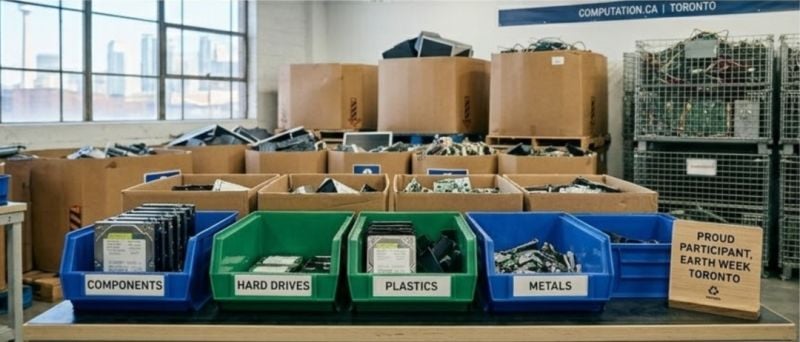
Why old drives become a year-end risk
Many office upgrades in 2026 trace back to Microsoft ending support for Windows 10 on October 14, 2025. Computers that could not move to Windows 11 have been replaced in waves, and every replaced desktop or laptop carries a drive that may still hold client files, saved passwords, email archives, payroll records and accounting data. Deleting files or reformatting a drive removes the index that points to the data, not necessarily the data itself, so information can often be recovered with freely available tools.
Canadian privacy law places that responsibility on the organization that collected the information. Under PIPEDA, personal information that is no longer required should be destroyed, erased or made anonymous. Computation's data destruction guidance also points to frameworks such as GLBA, Sarbanes-Oxley and ISO 27001 for organizations that operate across the border or follow international security standards. For a dental office, law firm, accounting practice, property manager or retailer, a single unwiped laptop can turn into a reportable privacy incident.
Three destruction methods, matched to the device
Computation does not apply one method to every job. The approach is chosen in discussion with each client, based on the type of storage media, whether the hardware will be reused, and the level of assurance the client needs.
When a drive is in good condition and the equipment can be reused, the company sanitizes it with specialized disk wiping software that follows specifications published by the RCMP and the U.S. Department of Defense, overwriting each bit of data between 3 and 30 times. Working computers can then go back into service through reuse and refurbishment instead of being scrapped.
When a drive has failed, holds highly sensitive records, or simply should not be reused, physical destruction is used. Computation's two-stage process starts by puncturing each hard drive platter with a drill bit, after which the punctured units are collected and sent to a smelter to be melted. For larger volumes and for solid-state drives (SSDs), USB keys and other storage media, the company uses industrial hard drive shredders in Toronto that reduce the media to fragments that cannot be rebuilt. Shredding matters more as offices swap spinning hard disks for SSDs, because the way SSDs store and relocate data internally makes software overwriting less predictable than it is on a traditional hard disk drive.
A paper trail for every project
The company says the record of destruction is as important as the destruction itself. Each project is tracked through Computation's asset management system and closed with a project report or certificate that can be tailored to the client's reporting requirements. That gives IT managers, auditors and compliance staff a clear record of which assets were processed and how, which is useful when an insurer, auditor or client later asks how retired equipment was handled.
From data destruction to computer recycling
Once the data has been dealt with, the hardware still needs a responsible destination. Computation has provided computer recycling and e-waste management alongside secure data destruction since 2001, and applies a 3Rs model to every device that enters its facilities: reuse comes first, and when reuse is not practical or permitted, the remaining materials are recycled. Desktops, laptops, servers, monitors, printers and networking equipment contain metals such as gold, copper, zinc and palladium, along with plastics and glass, that can be recovered instead of being sent to landfill.
Logistics are often what delays an office cleanup, so the company offers pick-up service for anything from a single device to a full truckload. With facilities and logistics teams in Toronto, Ottawa, Calgary, Vancouver, Winnipeg and Montreal, organizations with several locations can follow one electronics recycling process across all of their offices.
A simple checklist before equipment leaves the office
Before booking an upgrade or electronics recycling project, Computation suggests that businesses list every device being retired, including laptops returned by former employees and drives pulled from old servers. They should then decide which machines will be reused and which drives will be destroyed, back up and verify any data that needs to be kept, and ask for a destruction certificate before anything leaves the premises. Handled in that order, an office refresh ends with new equipment in service, old data gone for good, and documentation on file.
Toronto businesses and residents can arrange hard disk destruction, computer recycling or an equipment pick-up by calling 416.629.5667, emailing [email protected], or visiting the company at 280 Jane St., Toronto. The location is open Monday to Friday from 10 a.m. to 7 p.m. and on weekends from 10 a.m. to 6 p.m.
About Computation Ltd.
Computation Ltd. is a Toronto-based technology services provider specializing in computer repair, laptop repair, IT support, server maintenance, data recovery, network administration, data destruction, IT asset management, and related technical services. The company has been serving clients across Canada since 2001.
Contact Info:
Name: George
Email: Send Email
Organization: Computation Ltd.
Website: https://computation.ca/
Release ID: 89208378
In case of encountering any inaccuracies, problems, or queries arising from the content shared in this press release that necessitate action, or if you require assistance with a press release takedown, we urge you to notify us at [email protected] (it is important to note that this email is the authorized channel for such matters, sending multiple emails to multiple addresses does not necessarily help expedite your request). Our responsive team will be readily available to promptly address your concerns within 8 hours, resolving any identified issues diligently or guiding you through the necessary steps for removal. The provision of accurate and dependable information is our primary focus.
More News

Trump Is Watching Fox News, and He Is Not Thrilled
On a consequential midterm night, the president offered some harsh criticism of the cable news channel on his social media account.

Flouting Consumer Law, Insurers Refuse to Pay Medical Bills for Emergency Care
A law to end surprise medical bills has generated millions of high-dollar payouts for doctors. Health plans are now fighting back by frequently withholding money.

Drone Boat Maker Saildrone Wins Protest Over Navy Contract
A federal judge’s ruling on the side of the small defense contractor was a rarity, as most company protests against government bidding decisions do not prevail.

No more rice grains in Kellogg's Rice Krispies due to changing weather
The new recipes mean cereal packaging will now include a 'contains wheat gluten' warning.

How the 2010s Put Travel in Our Pockets: Instagram, Roaming and Live Translation
Geo-tagged dining, biometric gates, luxury grooved luggage, gifting Toberlones – the 2010s made travel hyper-connected and high-flavour. The post How the 2010s Put Travel in Our Pockets: Instagram, Roaming and Live Translation appeared first on Business Traveller.

How the 1970s Launched Modern Travel: Concorde, GPS and Airline Miles
We celebrate 50 years of business traveller with 50 things that have made working on the move better since 1976 The post How the 1970s Launched Modern Travel: Concorde, GPS and Airline Miles appeared first on Business Traveller.

How the 2020s Reimagined the Journey: Starlink, Sunrise and Craft Beer
As ultra-marathon flights connect distant corners of the globe and lounge hospitality goes hyper-local, the 2020s set the stage for the next half-century of life on the road. The post How the 2020s Reimagined the Journey: Starlink, Sunrise and Craft Beer appeared first on Business Traveller.

How the 1990s Connected the Globe: Mandela, Eurostar and Low-Cost Flights
From whizzing between European capitals to watching blockbuster films on your seatback TV, this decade brought speed, comfort, and entertainment to the fore. The post How the 1990s Connected the Globe: Mandela, Eurostar and Low-Cost Flights appeared first on Business Traveller.

How the 1980s Lightened the Load: Wheeled Cases and Platinum Cards
The decade that put wheels on suitcases, brick phones in hands, and independent flair in business hotels, just don't forget the Platinum Card. The post How the 1980s Lightened the Load: Wheeled Cases and Platinum Cards appeared first on Business Traveller.

Canva announces major job cuts after 'our hardest year yet'
CEO Melanie Perkins says more than 1,000 staff will either lose their jobs or be asked to change roles.

Graduates are managing AI - but are they learning much else?
Graduates are spending more time managing AI, but are they missing out on other work experience?

Poundland supplier 'will lose millions' if retailer collapses
One of Poundland's suppliers will lose millions if it collapses, while other suppliers have said they would go under.
YOUR NEWS, OUR NETWORK.
Do you have Great News you want to tell the world?
Be it updates about your business or your community, you can make sure that it’s heard by submitting your story to our network reaching hundreds of news sites across 6 verticals.